

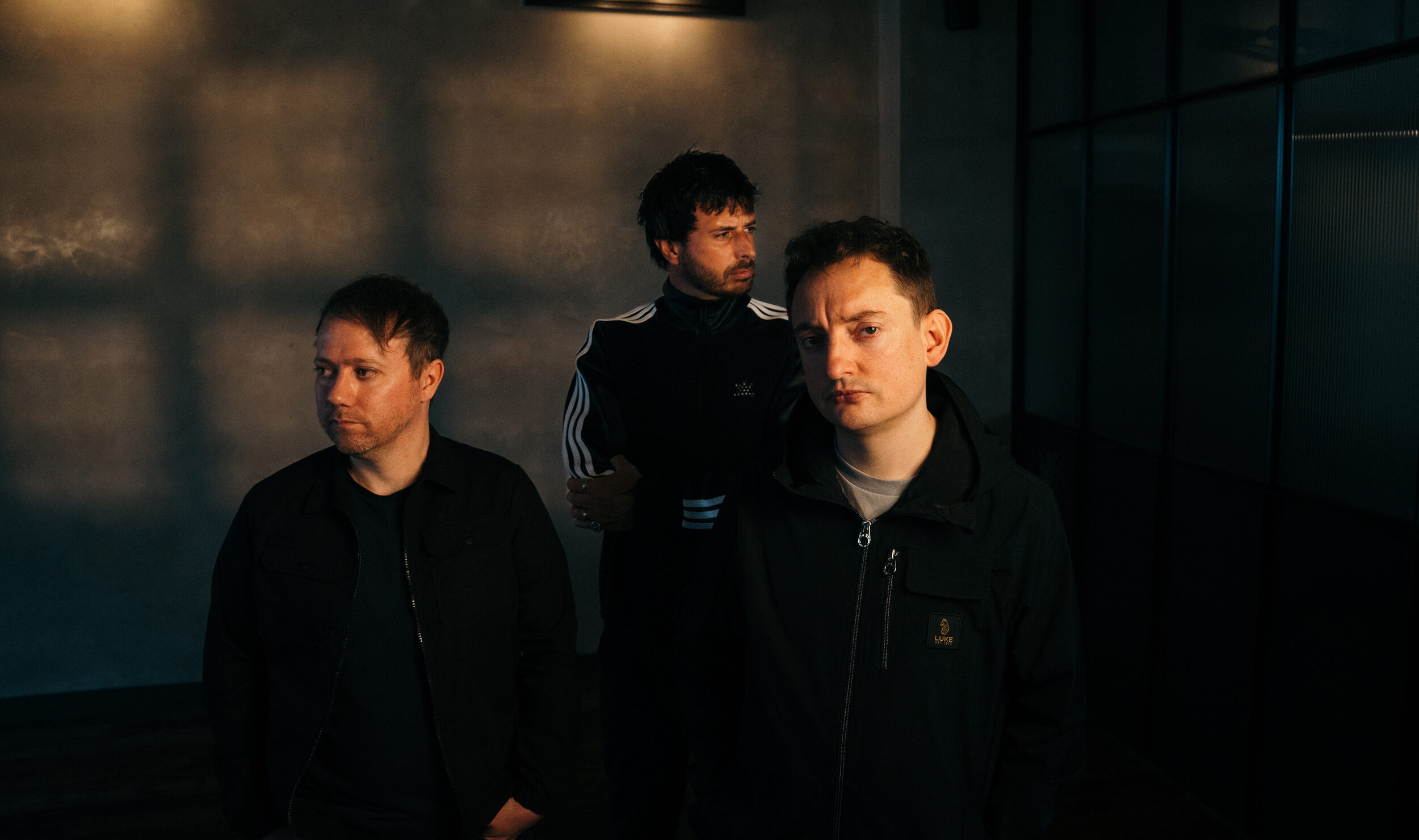

The Enemy have long been a mainstay of the British indie rock circuit – but they’ve also spent the last two decades overcoming more trials and tribulations than most.
We caught up with the band’s frontman and primary songwriter, Tom Clarke, to find out more about their new album, Social Disguises, and the road they took to get here.
You’re back with a new album, Social Disguises. Why are you releasing another The Enemy album at this stage in your life and career?
Well, to be brutally honest, we had no intention of doing so. The reunion tour was supposed to be just a one-off. I’ve been doing it solo for a bit, on my own. The first time round, the band had such a horrible time in the music industry. And then I went and started doing solo stuff afterwards, without the whole machine of the industry around it, and it was just a thoroughly nice experience in comparison – and I really wanted Liam and Andy to experience that.
So I basically hassled them and said, “Come and do some gigs. The fans will love it.” I just wanted them to see that it’s not how it was; that it didn’t have to be that way. And we all said, “Okay – but just a tour. We’re not going to get pressured into doing anything more than that.”
And we went and did a tour, and we all got on like a house on fire, like the good old days before we were signed to a major label. And we got to the end of it and said, “We just want to keep going.” And then the feedback we were getting from promoters was: if you want to keep going, there kind of needs to be new music.
And that is what put us on this train of thought of, ‘okay, well, maybe we make a new record then’.
.
In terms of the day-to-day nature of the job, is it harder to be in the band now than it was 20 years ago?
In some respects, yes, and in some respects, no. I’ve been chatting to people about this at length recently. I don’t think the music industry exists anymore. I think the big staples – the titans who used to be the taste-setters, who used to decide what was going to be massive – are no longer the major labels. There are a couple of them that still have power, but their power is exercised only with uber-pop and that proper A-list stuff. There’s no spread of genres within that much anymore.
You know, the titans of radio who used to control the route to market for all bands: they’re struggling for their own survival now. Likewise, the print media has declined massively since we were last doing this. And I think, to some extent, online media too is struggling.
And all of it is underpinned by one thing: when a new record came out, you used to have to listen to what John Peel or Zane Lowe thought about it to form an opinion of whether you would buy it, or go and read a review in the NME to work out, “Is this record worth my £10?” or whatever. And you don’t anymore. It’s free. You just go and listen to it for free on a streaming platform and figure out if you like it.
And it’s taken so much power away from the gatekeepers. So then, to answer your question: does that make things easier or harder for a band? It makes some things easier because you can get your music direct to fans, and those gatekeepers can’t just shut you out. But I think it’s harder than ever to reach people that aren’t already your fans, which means for others that’s a challenge. If you’re a new band, I can’t imagine how you begin to do it now.
The notion of a band scrapping around in independent venues that just don’t exist anymore, and then getting picked up and blowing up, seemingly overnight: that’s a romantic notion that might be dead nowadays. And it’s a real shame.
Yeah, that’s a pure fiction now. And I also don’t think record companies would speculate on a band that was going to be our size. I think they would look at signing us now and go: “Yeah, you might have a number one platinum record – that might happen – but that won’t be enough for us. We need international, ten-times platinum success to even warrant putting money into this.”
So yeah, I don’t know how you break a new band nowadays.
And on an adjacent point: is it harder to be an artist now than it was 20 years ago, or a songwriter?
For me, it’s easier, because the very fact that that machine has been destroyed means that I can just focus on… Like, I know how to write songs. I took my first music theory exam in infant/junior school, and I’ve intrinsically understood music from a really young age. That is my craft.
And when you’re part of that big machine, that craft is interfered with by people who have no idea what they’re talking about. And because that isn’t the case nowadays, I’m left to just focus on the only thing, really, that I’m good at – and do a good job at – and I can set the timescales. I haven’t got a record label going, “Okay, but you’ve got to deliver in the next month.” It’s like, well, this takes as long as it takes – within reason.
So no, I find it much easier now that it’s the Wild West and things are totally different.
.
Let’s go back to the album, and particularly the title (and the title track), Social Disguises. Can you talk me through that?
This is actually the first interview where I will have touched on this, but I had an autism diagnosis in my 30s, which I think probably explains a lot to a lot of people… I can be quite blunt sometimes.
And if you look back on the early press, in particular, I can be very, very matter of fact… To put it not bluntly. But, you know, ever since that diagnosis, I’ve started to understand myself, and the front that I put on. Basically, I don’t think in a neurotypical way; I think in a neurodivergent way. But for my whole adult life – and child life, I guess; my whole life – I’ve adapted to fit into neurotypical norms. But it’s exhausting.
So, you know, the lyrics in the song (Social Disguises) are kind of self-evident. I don’t want to talk about the weather. I’m not good with small talk. I feel like it’s wasted energy. If we’re in a social situation, that’s probably costing me quite a bit of energy anyway. And I would rather talk about something fascinating to me.
I’ll talk about weather fronts and how they work – if you’ve got some good information on that, I’d love to dive in; I’d love to learn that and digest that. But just, “Oh, it’s going to rain tomorrow.” Is it? I don’t care. I’ve got to start thinking about other things.
And it wasn’t a big intentional choice to write a song that personal. It just sort of came out. And then when we’d written the song and we went, “Oh, we really like that,” it kind of felt… Well, it’s a bit close to home. And I don’t normally do really personal songs like that. But the song worked, and I think it stood on its own two legs. And it would have felt wrong to just delete it and say, “Okay, but I’m not comfortable with it.”
One of the best things I’ve learned since that diagnosis is that there is a lot of value in becoming comfortable with things that you’re not comfortable with. That’s where growth comes from. So, I just decided, yeah – let’s stick it on the record.
Can I ask what led you to seek a diagnosis at that point in your life?
Anxiety, basically. I was struggling massively with anxiety. Years and years ago – I think probably around the third, maybe the fourth Enemy record – I had to give up alcohol. I’d really damaged my pancreas from drinking too much. And when I stopped drinking, I just found I was consumed with anxiety. I’d been using the drink to quieten down the fear – which is very effective but will pickle parts of your body.
And I reached a point where the anxiety was stopping me from living my life. I didn’t want to leave my house, really. So, I thought, well, I’ve got to go and get some help for this – which is tricky for our generation, because our parents’ generation never really did therapy, and they’ve never really encouraged it for our generation.
But if there is anyone out there struggling with stuff like that: go and get some help. It can change your life – not for everyone, but it certainly did for me.
But when I was doing the initial questionnaire to get access to the help for anxiety, it went down a line of questioning that I immediately recognised. Because throughout various points of my life, I’ve taken something called the “AQ-10”, which is basically a ten-question autism test, and I always scored incredibly high. And I went, “I can’t be…”. You know, I function; I go, I do things. It doesn’t look like the more severe cases of autism that you’d see. So, I always just went, “No – I can’t be.”
And they went down this line of questioning, and then I spoke to them more about it. And it was really a case of me starting to accept: okay, this looks different in different people. Some people are higher-functioning than others. But yeah – to answer your question – it was that initial attempt to get some help to understand anxiety. And really, finding the root of the anxiety was autism.
.
Retrospectively, do you think parts of your diagnosis have shaped you in your pursuit of songwriting and musicianship? Do you think it feeds into that side of your brain, or does it live adjacent to it?
I think what I do is a product of who I am. And I think that music, from a really, really young age, was who I was. I started learning violin when I was four. I started learning music theory at the same time, and sitting exams. That was because music was how I processed things.
For some people, music is like food: it’s something they enjoy. (Food might be a bad example, because you need that to survive.) For me, music isn’t just something that I put on and go, “Oh, I love that – I enjoyed listening to that.” The creative process of music has always been where I’ve processed things.
So my early memories are family visits to grandparents. I would go and find the piano, which was in a room away from everyone else, because I couldn’t handle the noise of the social situation. I would go and sit there, and I remember working out major or minor thirds as a four-year-old – I didn’t know what they were called, but I knew: once you hit it, once it happened, it’s sad… and I really like that. And you can move that up the keyboard and it translates to different keys – and you know, starting to find the patterns in music.
So, I think from that point – of being four years old and struggling with the social situation – music was my escape, and it was how I processed. It’s how it quietened my brain down. And I think it’s continued to be that my whole life, really.
As a songwriter, do you take a mathematical, theory-driven approach to your writing, or an emotive and gut-driven approach?
Emotive. Someone once tried to teach me about songwriting, you know – teach me the rules. I know the rules; I understand music theory. They were trying to say, “If you’re in C major, for example, you’ve got to use A minor. A major won’t work – it’s not the relative.” And I just remember going: “Well, what about Sittin’ on the Dock of the Bay, or Buck Rogers by Feeder?” These are all songs that throw those rules out the window and sound amazing.
So now I try to forget everything I know and draw on it subconsciously. You know, I can navigate my way around a keyboard because I understand music theory. But I try not to go, “Right, let’s go for a jazz standard.” I just try and let emotion drive that creative process, and I try not to overcomplicate it.
That’s particularly true for The Enemy. On my own solo stuff, there have been times when I’ve really tried to overcomplicate, and I’ve been quite happy with the result. But definitely for The Enemy, I try and keep it simple. I’m not looking for the most interestingly written song, musically – I’m looking to find a feeling that I think will translate.
Was there a moment in the writing and recording process for Social Disguises where something just ‘clicked’ – and you knew you were on track to make a great The Enemy record?
So, we wrote about 90 songs. The reason for doing that was twofold.
Reason one: previous The Enemy records have been rushed. I’ve had a record label go, “You’ve got to deliver it now, you’ve got to deliver it now.” And I’m going, “I haven’t written enough songs yet.” You know, for (debut album) We’ll Live and Die in These Towns, I wrote 38 songs to get ten – and I wasn’t able to do that on subsequent records. So part of it was just a fix for a previous era.
And then the second reason was because we decided quite early on that we were going to make this a double record. I think we’d only got six tracks that I was happy with at this point, but we decided that we’d make this a 20-track record. And I realised that, to get the kind of quality control that we wanted – to keep that 30-to-10 ratio – I needed to write at least 60 tracks. So I went into writing overdrive.
And the actual number of tracks I wrote is way above 100. There were 90-odd – I think 87 or something – that were actually demoed to completion. So the actual number of just going into my writing room and coming up with the songs: probably in the hundreds. And the process took two years.
There was a point where we probably had around 70, 80 songs where we’d all kind of agreed that those were the first ten, and those were not going to change. And then one of them did change. The last two of the last ten, we really struggled to lock in.
There wasn’t that click of “Yep, that’s it.” There was a lot of compromise between us because I really liked some, and Liam really liked some. And it was kind of, “Look, we’re approaching the end of the album sessions. Which do we go and finish?”
And there was a really nice conversation where we all just put forward views on each song. And we ended up finishing some ones that I probably wouldn’t have, because Liam really believed in them. So that last bit wasn’t a click – it was a general forming, I think, when we had an abundance of songs.
Was it a similarly happy conversation for that first album? Was there ever any real conflict within the band as to what’s going to make that, or any, record?
No. But I do remember having a full-on argument about whether Happy Birthday Jane should be on the record. There were people in our team who just hated it. And I really believed in it. There were several key people in our team who just said, “It’s a good song, but we don’t think it fits on the record.”
I look back now with almost 20 years to reflect on that record, and I think that song is one of the most important because it provides the balance. Without that song, you could look at the band and go: “One-trick pony.” But that song kind of showed we can slow this right down and create these heartfelt moments with just simple melody – which I think is fundamental to what the band does. It’s easy for that to get lost in the volume of it all.
.
How conscious were you that this, to continue the momentum from your reunion tour – and to allow you to carry on being in this band – Social Disguises had to be an up-tempo guitar record?
It was very conscious. When I started making this record, before I could write a note, I had to answer a question, which is: what does The Enemy sound like?
And I know that for people who’ve just listened to The Enemy, you could probably describe what The Enemy sounds like. But because I’m in it, I have no idea what we sound like. I know what I do – what my bit of it is. And I can identify patterns of repetition in the choruses, and I could draw the general shape of an Enemy song. But in order to begin this record, I had to reverse-engineer The Enemy.
So, I looked at that first record, because we wanted this record to kind of pick up where that one left off – because that one was the only one we made without massive involvement from the industry. And I reverse-engineered it.
And what I found kind of surprised me. The guitar isn’t that complex. The bass does a lot of the heavy lifting. So I made note of that. And I went, “Right – I mean, that makes my life easier and Andy’s harder. That’s great.” But I realised: oh, it’s not what I thought. I think of it as a guitar band – a six-string guitar band – but the guitars are almost there for padding a lot of the time, or rhythmical, percussive elements. The bass is what interacts with the vocal and creates the Enemy sound.
So once I hit on that, I then started trying to reverse-engineer specific songs. I knew I wanted something that reflected Had Enough on the record, and that’s where Trouble came from – me going, “Okay, let’s find something at that tempo, with that kind of punch.” And there were probably ten songs written in that vein, at that tempo. And Trouble was the one where, early in the writing process, we thought: “That’s got something, that’s got legs.”
And likewise, I knew I wanted something in the vein of No Time for Tears, which was actually written for the first record but didn’t make it. And The Boxer filled that gap. But again, there were lots of those songs written that didn’t make it.
And The Last Time was very much… I was looking for something that filled the shape of Away From Here. It didn’t have to be as big and as forthright as Away From Here, but it needed to fill that general footprint.
Because I knew that beyond what makes an Enemy song an Enemy song, there was the question of what makes an Enemy record an Enemy record. For a lot of people, We’ll Live and Die in These Towns is the Enemy record. So, there was a lot of reverse-engineering – a lot of conscious thought went into it.
As a man who’s well-versed in music theory, did you experience any ‘anti-indie’ snobbery from the industry and media during the first phase of your career? And do you think that’s as evident now as it might’ve been back then?
I think it’s more evident now because we’ve, for some reason, attached the negative word “sleaze” to the end of the name of our genre.
And I don’t think there are any working-class people in indie bands who have attached the word “sleaze.” We’ve all probably got families, and are good, honest, hardworking people. I don’t think any of those people have attached the word “sleaze.” I think the people who have attached the word “sleaze” are generally journalists.
You know, there is absolutely an elite set of gatekeepers within the music industry. It’s hard to get into the world of media – the gates are guarded fiercely, particularly for working-class people. And then those very people who do make it in the media – who tend to have not come from working-class backgrounds – I think often don’t understand it.
That could be innocent: “I just don’t get this indie stuff.” Or it could be more malicious. It could be that, maybe, they fear it.
.
Do you think as many people give as much of a shit about music now as they did 20 years ago?
I think that the value of music has changed. You used to invest in music… I remember I would queue up for a record, I’d go and buy it, and that’s an investment – an investment of money and time. And by the time I put that record on, I would want to love it, and I want to come away from that going, “This has really added something to my life.” When you’re young and a record’s a tenner, that’s a lot of money.
That investment doesn’t happen anymore. So I think people are generally just more nonchalant about music. It’s become something that complements their day rather than a really important part of their day.
I’m guilty of it too. I used to sit down specifically to listen to an album. I would pick it apart and analyse it and find the Easter eggs in it. And now I put an album on while I’m doing other stuff and I go, “Oh, that song was alright. That one popped out.”
So yeah, I think it’s just changed, in that people are less invested. And it’s a shame, because when you do take the time to listen to a record – in the way that we used to listen to records when we were kids – it can be transformative. All the same magic is still there. I think maybe we just forget to look for it.
And has that approach impacted your relationship with consuming other forms of art?
The older I get, the more I’m into visual art. I used to really struggle to understand it – which also, to briefly touch on autism, I think is quite common for a lot of people as well, because it’s not literal.
But I feel like, from what I’ve seen of the visual art world, there are lots of things that are almost a mirror image of music. There are gatekeepers; there’s classism. But I think in many ways, the visual arts got there first. They became decoration rather than things you would stop and focus on. And we totally take that for granted.
You can walk down a corridor with ten pictures on the wall and you won’t stop and look at any of them. And I feel that actually that’s where music has gotten closer to that over the years as we’ve switched to streaming. I would suggest music has become decorative wall art rather than the masterpieces that used to be created by the greats.
.
It certainly feels that there were fewer cultural moments now, in a musical sense.
The last culturally significant artist to break, musically – I don’t even know the answer to that.
Visual arts: maybe Banksy, and before that Damien hurst. Those were a long time ago. And the same with music. There are bands and artists who pop up now and have some success, but when was the last Oasis? It might have been Oasis. And before that, when was the last The Rolling Stones? There’ve been no juggernauts.
I think people are striving for nostalgia and comfort more than they are innovation, sometimes. And I think that craving for nostalgia might be evidence of a society in decline. I think that might be the public en masse feeling that things used to be better, and that we’d rather go backwards than forwards because we don’t like the direction that we’re in.
I don’t know. It poses a deeper, more philosophical question of: why are we looking back? Is that just our generation? Are the kids in their 20s looking forward? Are the kids in their 20s going, “We don’t care about this. We don’t care about The Enemy. We don’t care about the Arctic Monkeys. We want something that you guys don’t even understand.”
So maybe it’s a society in decline, or maybe it’s a passing of the baton to a generation who are excited about the future and aren’t looking back. I don’t know.
.
What have you been listening to, watching, or reading lately? And does that differ from what you were consuming during the writing and recording process for Social Disguises?
So, during the writing and recording process, I banned myself from listening to anything, because it’s impossible not to be influenced. I’m not going to say what it is because I don’t want to get sued, but I realised where I found the top-line melody for Away From Here the other day from listening to just a playlist that I didn’t create on Spotify.
This song came on and I went, “They’ve stolen my melody.” And then I realised their song existed before mine, and I’d probably heard it, and subconsciously was just repeating it. That happens when you create music – it happens to everyone. It’s impossible not to. People have used elements of our stuff that you could quite easily go to court and argue, “That’s too close.” I never will, because I just think it’s human nature.
I think it used to be something that we celebrated: the passing on of folk songs, of melodies, of stories and lessons learned. So unless I feel it’s malicious, I’ll never pursue that. But I am conscious, when I’m making stuff myself, that I want to be as original as possible.
So I banned myself from listening to stuff throughout the whole process, pretty much. Which is horrible, because I love consuming music. In fact, the only thing that I listened to when I’m in that process is jazz, because I know it’s impossible for anything from there to accidentally step into The Enemy.
It’s an interesting question. What do I consume now? Actually, records from about five, ten years ago. I think it takes me a while to understand music. I’ll listen to stuff The Strokes put out ten years ago, and I’m like, “Oh – I didn’t get that at the time, but now I like it.”
And that is inevitably me struggling to process change. There’s a new sound, and I’m like, “That’s not my favourite band – they sound like whatever the record is that is my favourite of theirs.” And then it takes me five to ten years to process that, actually, that’s really good.
I love what Foals are doing. Foals are doing some really clever stuff with low-end frequencies. I can’t figure it out, but it makes me want to listen to their records to try and work out: how are they getting this richness in the low end? So I like listening to that.
I just opened my Spotify to have a look. I love Vulfpeck – just the musicianship. And then there’s classic Pink Floyd records that I listen to probably on a weekly basis. LCD Soundsystem, I’ve been playing a lot lately. So, I don’t know – I’m kind of all over the shop. Not as hot on super-new music now as I was maybe ten years ago. But I just kind of like what I like.
When you listen to a new album for the first time, there’s a point where you don’t know if the next song is coming or if the record is finished. When somebody in that moment realises that they’ve just finished listening to Social Disguises, how do you want them to feel?
I don’t know if I want them to feel any sort of way, but I’d love to know how they do feel.
Because I’ve been doing this long enough now… Look, this is The Enemy’s fifth album, and my seventh studio record I’ve made. What I do realise is that basically I don’t know anything. Like, I think I know what this song’s going to do for people, and then people come and tell me stories about how that song means something to them that is totally different.
The only thing I hope is that it’s a net positive. That’s all I hope. I hope it just makes people happy and smile. Maybe provides that bit of escapism we were talking about earlier. For me, it served its purpose. On a “we run a small business” point of view, it will sustain the band and allow us to keep doing what we want to do. On a personal point of view, this record has righted so many wrongs for me. This is how I want to make records. I want to take two years to craft songs because they last forever.
And they’re going to outlive me. Whether people listen to them or not, they’re going to exist. And it’s been such a cathartic process for me to make a record properly. I’m just happy we did it, and I’m really proud of it.
I hope that, if anything, people can sense the amount of love and care that’s gone into it.
