

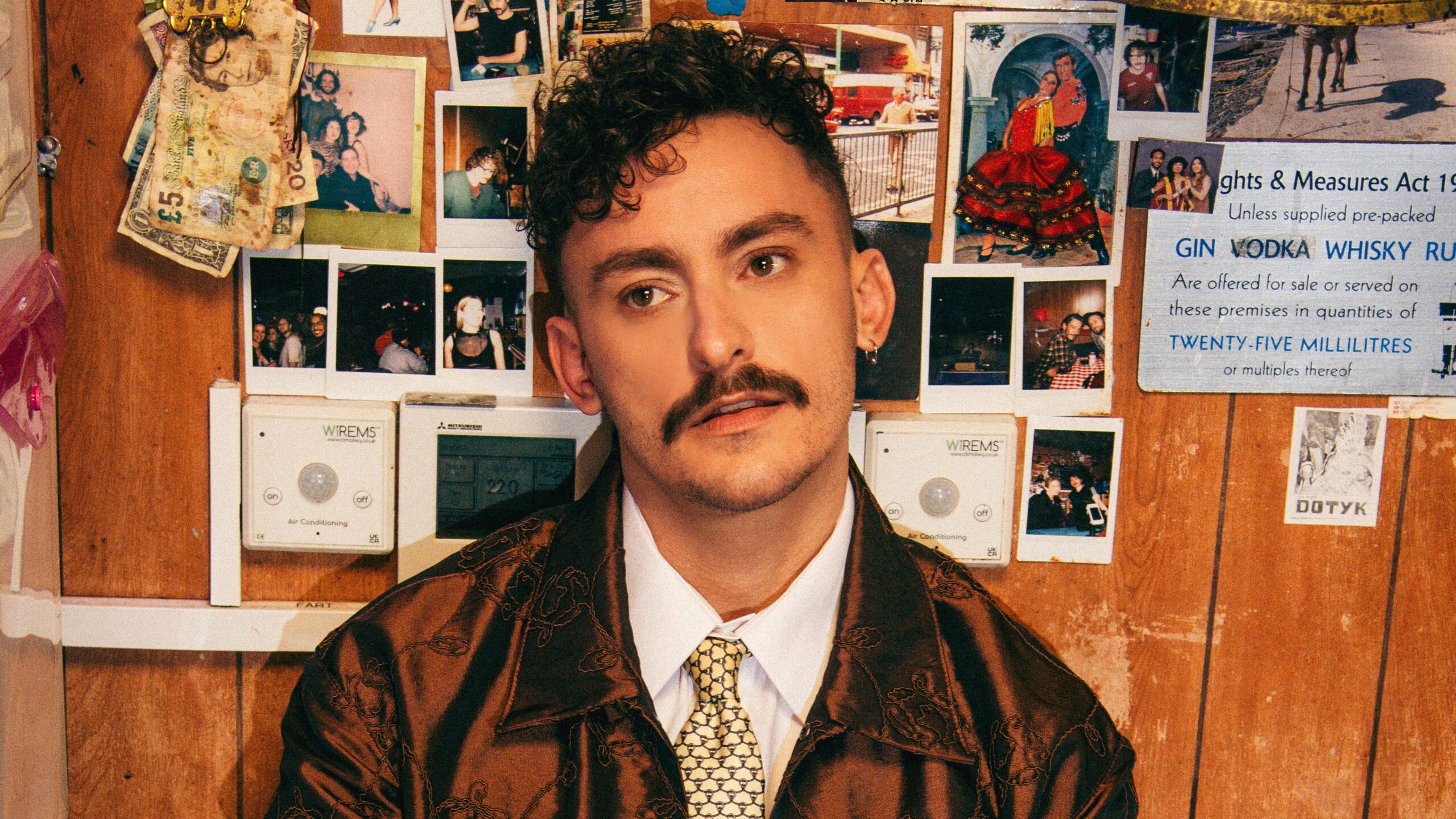

The Manchester poet, writer and producer talks Decoding Birdsong, Bristol, birdwatching, vulnerability and finding his own version of the music industry.
Ahead of his second album, Antony Szmierek spoke to One on One about writing in motion, the strange comfort of signs from the universe, and why he wants the end of the record to feel like the credits rolling on a very good film.
How are you doing, Antony Szmierek?
‘I’m not bad at all. I’m in the middle of putting the singles out and [the album release] is getting close now. I keep thinking that September and October are ages away, but I’ve just watched them disappear in the last few days. It’s really busy. I keep thinking of September as if it’s six months away, and it’s next month. So it’s getting exciting, but I’m a human being and there’s an element of anxiety and, ‘s***, I’ve got to go and do all of that [album release stuff] again’. It’s a big mental undertaking, really, to go out and meet everybody and do all of it again.’
That vulnerability of putting a part of yourself out into the world is underestimated. Does that get easier?
‘My fear of being honest in the songs has sort of gone, in quite an unusual way. Now I just don’t really think about that. Especially with the second album. The first one had its personal elements, obviously, but this one really is a blow-by-blow account of last year, sort of disguised beneath metaphors, and maybe less so than the first one in places. So yeah, it’s super personal.’
.
Do you consider yourself more of a songwriter or a storyteller?
‘They’re both good things that I consider myself, depending on which day. The thing I do struggle with is calling myself a musician. I feel like there’s a lot of explanation around it for me. I still have a bit of a chip on my shoulder with that. I go and watch bands all the time and I’m just like, I’m not that. I can perform. I can tell stories. I think they’re all stories, really.’
‘They’re all little short stories, and songwriting is something that I’ve really started to fall in love with over the last year. That was working with some of the collaborators on the record, like Imogen and the Knife. We’ve been writing some other stuff as well, and she’s an incredible songwriter. Also, I think these two big dance records that we’ve put out, and my craving now, because of this falling in love with songwriting, is: can I do something that’s like a Leonard Cohen record, or like a Nick Cave record? Is that in my wheelhouse?’
‘But yeah, currently doing that and learning that bit as well is quite nice, because it keeps my interest in the dance music as well. It helps me do both things. But yeah, both and neither, I guess, is the answer.’
Does a great song need great lyrics?
‘I think the answer to that is no. But the lyrics are funny. I’ve done this thing for ages about prising apart: what makes a poem? What’s a poem and what’s a song? For a poem to be a poem, you have to be able to consume it on its own, really. Can you read it written down, and does it still work without music behind it? Some songs don’t work as poems without the music. I think that’s an easy distinction.’
‘There are lots of really good songs that don’t have good lyrics. But the whole point of this, really, is: what if dance music had interesting and unusual lyrics? That’s kind of the mission statement for me. I fall in this really strange Venn diagram. It’s half an alternative project and half an electronic dance music project, and I’m in neither world, but that’s helpful to me.’
‘Recently, watching what a lot of my peers are doing, and people I’m a fan of, you can see the direction a lot of bands are going in, and it’s this dancy, post-punk sort of thing. I think it’s quite fun that if you look at ‘Seminal’, no one’s doing garage; it’s not cool at the minute or whatever. I think it cuts through a little bit. It’s not a garage record. There are a few on there, but it’s still got this big guitar riff on it. It’s like, how do you bring this UKG, noughties thing? How do you make that sound like a band’s playing it? It just interests me. All of the trends and everything really interest me. Where do I sit? Maybe that’s why I’ve managed to get this far, because it’s three different things trying to fight for it. That might be where I’ve survived.’
.
You’re living in Bristol now. Is that helping with the project and your headspace?
‘I feel like I’m settling in more and more, actually. I’ve not been here much. I moved in January and I’ve been here for six months now, but probably only three of those months, because I travel around a lot. It’s a big breath out when you get to Temple Meads. I love being here. I love the water. I’m taking a lot from it, personally.’
‘I’m not here for the Stokes Croft of it all, really. You could be, and I guess that’s the thing with Bristol: you go to the pub, say yes to one thing, and you end up on a canal boat at a 160 BPM party. You only have to say yes to one thing. But yeah, I love it. It’s really helping me.’
‘I feel a lot more in control of my own happiness and the project and everything this time. The first record, and how quickly it all happened to me, and the change in my life, you don’t really know when you’re in the middle of it, but it was quite shocking for the central nervous system. It’s still up and down, but I feel a lot better this year. I feel a lot more confident that I can do this and be happy at the same time.’
The idea that you have to suffer to make great art is a bad one. Do you think that myth still hangs around artists?
‘It’s obviously an age-old debate: do you have to suffer to make good art? The annoying part of that is that when people do suffer, they do make good art. So, it doesn’t prove a point, but there’s evidence that suggests that works. But no, I really don’t think you do have to suffer to make great art.’
‘I mean, this album is born out of some suffering. A breakup at the start of the year. Sacking a manager, but it was for the right reasons. It was bad. Break up in January, that was in March, and then lots of other different, confusing personal tales of woe. So that’s what’s come out of this. Maybe this one does prove that suffering makes great art. Maybe the third one I can be happy and relaxed. Buy a boat.’
.
Did you know what this album was about while you were writing it, or did it become apparent after you put the pieces together?
‘Again, you’re never going to get a straight answer from me, unfortunately. I talk about the bothness a lot. It’s something I talk about to my friends, where both things can be true at the same time. It was a bit of both. A lot of it I was writing in the van on tour last March, when we were touring Service Station At The End Of The Universe. I think a lot of writers find that when you’re in motion, or when you’re tired or hungover, you don’t second guess the words as much. You can get into a bit of a flow state with being honest, and things sometimes just tumble out.’
‘So it was last March and I was right in the middle of everything, in terms of personal life changes and things like that. I had all of these desperate ideas. The heron was something that, when I was struggling last year, I’d go to the River Mersey and see the same bird every day. It was the same heron. I watched her have babies and all of these different things. It felt like a real spiritual sign from the universe, really. I was clamouring for that last year. I was clamouring for coincidence.’
‘That’s why I keep talking about the album like coincidence is a religion. That’s become my belief system: seeing these little signs. Seeing the birds became a big thing, but also certain songs playing at certain times, certain things that would remind me of people. I did feel very lucky last year. I felt like I’d slipped into a Truman Show-esque existence. It was like I was in some sort of universe slipstream and nothing could go wrong. So I was looking for all of that sort of stuff, I think.’
‘That’s what it was originally. It was about luck and the consequences of luck. What happens when you’re lucky, and what are the consequences of it? Then all of the symbols started coming in, and the album was called The Heron at first. Then this phrase resurfaced: Decoding Birdsong. There was one article I read, I think it was in the New York Times, in 2024. It was like, a scientist learns how to decode birdsong, and that’s where I got the phrase from.’
‘But it’s like birding or twitching or whatever. It’s having this real moment all of a sudden. Everyone’s downloading this Merlin app. There’s a really cool documentary called Listers, which you can watch for free on YouTube. I weirdly feel like either I got ahead of the zeitgeist there, or it was happening and I didn’t realise. Decoding Birdsong was just a wider version of what The Heron was supposed to mean. It’s taking signs from the universe and trying to understand them. That’s basically what decoding birdsong means.’
‘And then yeah, it was all these little symbols. The heron, as you see on the album, is mentioned a couple of times across the record as a bit of glue. The title track, ‘Decoding Birdsong’, is the second-to-last song, but it doesn’t say ‘Decoding Birdsong’. I say it for the first time in ‘Aussie Gold Hunters’, in the last track. I think I had all the ideas and I tried to sew them together, and it was right in front of my eyes what I was supposed to do. The first one was about characters that were bringing it together, whereas this one is these objects and symbols. There’s the heron, there’s dice, there are a few different things across the songs. That happened on its own, I think.’
.
Have you always been the kind of person who puts faith in a higher power, or the universe, or does that faith in coincidence happen as you get older?
‘I was raised Catholic, so I’m a lapsed Catholic. I went to Catholic school. It’s not part of my life anymore, but maybe that’s inbuilt in there somewhere. There are these big things, like communion or church. Football, for people, is that, and I don’t have football. So live music was always my communion and my gathering of souls, and that feeling of all these people being together in this community that I think we need.’
‘I’ve always had a really vivid imagination, obviously, since being a kid. I’ve always secretly wanted to really believe in magic. I wanted to believe in ghosts and aliens, and that there’s a reason for things. I’ve always been clamouring for that sort of stuff. Of course I don’t believe in that sort of stuff, but then also I do, in a strange way. I really want those things to be true.’
‘I always think one day the sky is just going to split open and someone’s going to poke their head through and be like, ‘All right, sorry, but this is the answer. This is why you’re here. You’re in a zoo or something.’ That’s what writing is, and that’s what I think good art is. It’s sort of prodding at the unanswerable questions. That’s what a good painting can do. That’s what a good song can do. The concept of ‘Rafters’ from the last album is basically: what if someone just told you, this is why you’re here? It’d f*** us up, probably.’
Would people actually want to hear the truth?
‘No. I also think we’re so post-truth now that if there was an answer… I went to see Disclosure Day last week. I go to the cinema when I’m really stressed. One of the last things I have that calms me down is going to the cinema on my own. I’m in a dark room. I can’t be on my phone, and I can settle in.’
‘The reason Disclosure Day kind of doesn’t work is because if the news suddenly arrived and said, aliens are real, and it had been doing that for six months, here’s an alien, we’d just never believe it. We’re so post-truth. We’ve seen everything, so we would never believe anything anyway. If God appeared to us tomorrow, no one would believe that that was true. Awful.’
.
On first listen, the record felt like it had songs about a man trying to work out his place in the music industry. Then, on second listen, that seemed to expand into a lot more of life. Does that feel right?
‘It’s interesting. That’s probably the way it should be, that on first listen you pick that up and then it expands out a little bit. There are songs where ‘Bookie’s Favourite’ is about that, and the end of ‘Chalk’ is about me sacking my manager. It’s the angriest song I really have, ‘Chalk’. But yeah, it is trying to find my way in it. I always think of it as a broader thing. For me, the reference was that my life had changed in the music industry, and I was trying to find my place in it. But it’s that thing: you’re always hoping something’s going to happen. Then what are you supposed to do when it does? No one can prepare you. It’s so unexpected. It’s probably the same with someone having children, moving to a different country, or any huge life change.’
‘What are you supposed to do when the thing you’ve always imagined actually happens? What if you’re not as good at it as you thought you were going to be? What if you have to run away from home? What if it affects your relationships? All of that has happened. I’ve literally run away from home. I’ve come to Bristol because my ability to be happy in Manchester was starting to be taken away from me a little bit. I was always looking over my shoulder, and a lot of my friends I’ve grown up with have normal jobs, I suppose. I was on my own a lot when I was home, because everyone was doing their lives and I disappeared for four years to do this. Here, I have more friends who do the same job as I do, and we have these conversations every day.’
‘I’ll go for a coffee with Getdown Services or BIG SPECIAL and we’re all the same. I have friends who come down who are fans of those bands, and they’ll listen to me and Josh from Getdown talking on the way back from a gig, and they’ll be like, ‘f*** you both.’ We’re both just going, ‘I don’t know if this is going to last’, or ‘what if everyone hates us?’, or ‘people think we’re s***’, or ‘someone called me this online.’ It’s so funny how different it is from what you’re seeing online. How we all are.’
Is that sensitivity something that’s changed in you through doing this?
‘We’re all sensitive souls, and I think I’m getting more sensitive from doing this. When I started teaching, when I was 23, that changed me. Suddenly I could cry at things. It was like having children. I really learnt about the world and community, and became this dangerously sensitive person, really.’
‘But it helps with my job. It’s the same with this. The more I pull at it and prise it apart, and the more I try and write honestly, and the more I become a noticer and wander around and try to notice things and think about what’s below the surface, I find it’s made me a really emotional person.’
‘Last year, I was saying in all the interviews for the first record, ‘I cry every day.’ I was crying every day, and I now look back and go, I think I was so stressed. I cry some days now, and I’m still a crier, but I do think maybe I’m calming that down. I feel very emotional about stuff. I saw a kid get out of a car holding a little toy the other day, and I just burst into tears. I was like, I used to be him. He used to have no worries, and look at this child with the world ahead of him. It f**** me up.’
‘You’re the same person. You’re the same child. You are. It wasn’t even long ago. You were a little baby in year two on wet break 10 minutes ago, and then we’re expected to do all of this. It’s frightening.’
.
Are there any parts of your job now where, if someone had told you it was like this before you got into it, you might have thought twice?
‘No. Do you know what? For all of its difficulties, what I’ve started to do over the last year is carve my own version of it out. I say that line in ‘Chalk’ and things like that. I’ve seen it over the last few years. I’ve been to the parties. I’ve seen it, and then you just realise: they won’t make me happy. I don’t want that. I never wanted it enough to go far enough down that road to f*** myself up. I’ve seen people damaged by it. I think you’ve just got to figure out what your own version of it is. There’s a way you can enjoy it, but you’ve got to know yourself.’
‘I mean, I’m 35. I know myself. I know who I am. I’m not trying to be anybody else. I don’t need to be part of a scene or anything. I’ve found people who I think are kind and like me, and they’re the people I want to be around. I’m so happy that I’m not in my early 20s, chasing a certain image or a certain scene. When I’m making something, or making a video, I never really think, is this cool? Are people going to think this is s***? You have all of those doubts, but I trust my own version of who I am enough to go, this is what I’m going to put out. That protects me from it.’
‘There’s a lot of awful stuff to it, but your naivety quickly gets knocked out of you. All the awards that you used to care about, they’re all bought. That’s just how it works. It’s fine. If you want a BRIT Award, you’ll be on a major label and someone’s paid for it. Even with prizes that we hold in high regard, there are 12 slots, for instance, and 10 of those go to major labels. Two of them are campaigned for by friends of friends, or one jazz act gets it. But once you get all of that, once you realise all of that and see it all, then you just go, what am I doing here then?’
‘I’m trying to help people, and music is such a joy in my life. Can I be a transmitter of that? Can I make people feel happy when they’re on the bus on the way to work? Can this song be someone’s first kiss? Can this song be played at somebody’s wedding? That’s it. If you’ve got that, then you’re all right, I think. That’s my purpose, and the way I get meaning from being here. Teaching was a very similar thing, but now I’m here to do that. If other things happen and fall into place alongside it, amazing. But ultimately, the thing that makes me happy is digesting things and chewing them up and spitting them back out in a mildly humorous and sort-of-wise way.’
.
When you’re listening to an album, there’s often that little gap at the end of the last song where you’re not sure if there’s another song coming, or if that’s the end of it. When people realise that’s the end of this record, how do you want them to feel?
‘That’s a good question. We’ve got this little bookend on this one. You’ve got the snooker ball getting knocked in. I do think the first time you hear it, it signals this song about snooker, and the album’s like, here we go. At the end of the album, when you hear it in reverse, the first time we added that in, it made me cry, because it became this cosmic effect. It just meant so much to me, the noise of the ball hitting another body. Everything became about the fleetingness of it, how we’re not here very long.’
‘I think it became this onwards message. It was like, there you go, take this and move with it. That’s what we did with that sound at the end. It bookends the record and it’s finished. But I kind of want people to feel like they do when they get out of a good film, or when the credits roll and you can’t quite leave the chair. Everyone’s leaving and everyone’s chatting, and people aren’t thinking about it as much as you, but you’re maybe fighting back tears, or you’re thinking, I should call her, or whatever. You’re glued to your seat, and you sit in the dark room for a bit longer than you thought you were going to. Maybe that’s what I want.’
